

We have become very good at recognising the challenges faced by people stepping away from high-intensity careers. When professional athletes retire, we understand that the transition can be abrupt and deeply unsettling. Their identity has been built around performance, discipline, and a clear sense of purpose, and when that suddenly disappears, the adjustment can be confronting. The same understanding is often extended to those leaving the military, where structure, identity and meaning are tightly bound to the role. In both cases, we accept that stepping away is not just a career change — it is a fundamental shift in identity.
And yet, we rarely extend that same level of understanding to retirement.
For many professionals, retirement represents a similar, if not identical, transition. Doctors, lawyers, executives, engineers — people who have spent decades building expertise, credibility and responsibility — often have their identity deeply intertwined with their work. Their role is not simply what they do each day; it becomes how they see themselves and how they are seen by others. Over time, their sense of value, relevance and contribution is reinforced through the work itself.
When that role ends, the change is often quiet but significant. There is no longer a clear structure to the day, no immediate feedback loop, and no defined place where their contribution is visible and recognised. What has been built over a lifetime does not disappear, but the context in which it existed does. This is where the challenge begins, not in the decision to retire, but in what comes next.
We tend to frame retirement as freedom — more time, fewer demands, the ability to do what you want. And while this is partly true, freedom without direction can quickly become disorienting. The routines that once provided momentum are gone. The problems that once required solving are no longer there. The sense of being needed, of contributing to something larger, can begin to fade if it is not intentionally replaced.
At its core, this is not about age. It is about identity.
The same underlying questions faced by an athlete retiring at 30 are often faced by someone retiring at 60 or 65. The circumstances may differ, but the psychological shift is remarkably similar. Without the role that once defined you, there is an inevitable pause where you are required to reconsider who you are and where your sense of purpose will now come from.
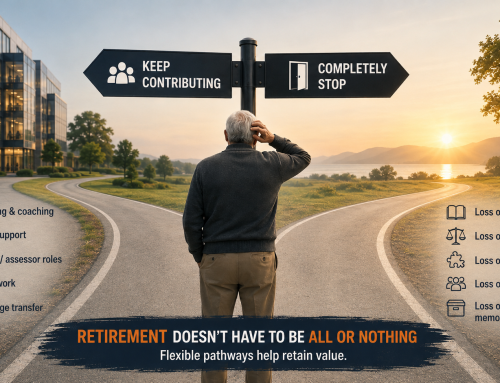
This is why retirement planning needs to extend beyond financial readiness. Financial security provides options, but it does not provide meaning. What matters just as much is psychological readiness — the ability to transition from a defined role into a self-directed sense of purpose. This requires thought and intention. It involves asking where contribution will come from, how experience and capability can still be applied, and what will replace the sense of progress and achievement that work once provided.
For some, this might take the form of mentoring, consulting or part-time work. For others, it may be found in community involvement, volunteering, creative pursuits or entirely new areas of learning. There is no single answer, but there is a common thread: the need to actively rebuild a sense of meaning rather than assuming it will naturally appear.
Perhaps the most important shift is recognising that this transition is not unique to any one stage of life. Whether someone leaves a defining role at 30, 45 or 65, the underlying experience is the same. You are moving from a structured, externally defined identity into one that you must now shape for yourself. That process can feel uncertain, but it also presents an opportunity to redefine what matters and how you want to contribute.
Handled without intention, this transition can lead to a gradual loss of direction and a quiet erosion of self-worth. Handled well, it can become one of the most meaningful and self-directed phases of life. The difference lies in whether the transition is acknowledged and prepared for.
It may be time we start treating retirement with the same level of respect we give to other major life transitions. Because for many people, it is not simply about stepping away from work. It is about working out who you are when the role that once defined you is no longer there.






Dr Susan Roberts says: