

When organisations think about workforce transition, the focus is often on roles, budgets and headcount. But there is another question that matters just as much:
How are people leaving the business?
For older workers approaching retirement, there is a big difference between someone leaving voluntarily, someone leaving through redundancy, and someone leaving after a workplace injury. Financially, operationally and culturally, those three exits are not equal.
If HR leaders want to reduce cost, protect knowledge and support a healthier ageing workforce, the best outcome is usually the simplest one:
A planned, voluntary retirement transition.
Not all exits cost the same
At first glance, one employee leaving may look like one employee leaving. In practice, the cost to the business can vary significantly depending on the pathway.
A voluntary retirement is usually the lowest-cost option. The business may still need to pay out accrued entitlements such as annual leave or long service leave, but there is generally no redundancy payment and no injury-related cost. It is a cleaner exit, easier to plan for, and far less disruptive.
A redundancy is more expensive. On top of accrued entitlements, the employer is often carrying notice obligations and redundancy pay. Even where redundancy is necessary, it is a more costly and more abrupt way for a long-serving employee to leave.
A workplace injury can be the most expensive and the most unpredictable pathway of all. There may be wage replacement, medical and rehabilitation costs, replacement labour, management time, lost productivity and possible insurance premium impacts. Beyond the dollars, it can also create stress, uncertainty and a difficult end to what may have been a loyal and lengthy career.
A simple comparison
Using a sample employee aged 67, earning $80,000 a year and with 25 years of full-time service, the cost difference can look like this:
| Exit pathway | Minimum cost | Likely cost | Worst-case cost |
| Voluntary retirement / resignation | $0 | $22,820 | $39,486 |
| Redundancy | $27,077 | $49,897 | $66,563 |
| Workplace injury / workers compensation | $15,000–$25,000 | $85,000–$130,000 | $150,000+ |
Even allowing for different leave balances and claim circumstances, the direction is clear:
Voluntary retirement is usually the lowest-cost exit pathway, redundancy is materially higher, and injury-related exits can become the most expensive of all.
The difference is not just financial
The real issue is not only what appears in the payroll exit figures.
When a person retires voluntarily and with planning, the business has a chance to manage the transition properly. Knowledge can be handed over. Successors can be supported. Workloads can be redistributed with thought rather than urgency. The employee leaves with dignity, and the organisation retains goodwill.
Redundancy tends to compress that process. Even where it is handled well, it often shortens the runway for handover and creates anxiety across the wider workforce.
Injury-related exits are harder again. They often come with uncertainty around timing, fitness for work, replacement arrangements and team impact. They can place pressure on managers, colleagues and the employee themselves. What could have been a constructive transition can instead become reactive, drawn out and costly.
What this means for HR
For HR, this raises an important strategic question:
Are we doing enough to make voluntary retirement the easiest and most supported path?
Many organisations invest heavily in attraction, engagement and retention, but give far less attention to the final stage of an employee’s working life. Yet this is exactly where thoughtful planning can reduce cost and improve outcomes for everyone involved.
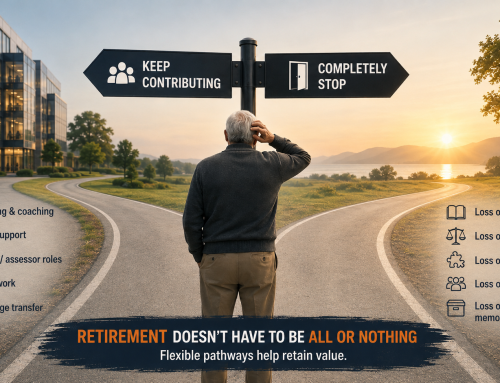
If an older worker feels they have only two choices — keep going until something forces the issue, or leave suddenly — the organisation has already lost an opportunity.
A well-supported retirement transition helps people leave before the business is dealing with redundancy, burnout, health decline or injury-related complications. It creates space for honest conversations, practical planning and a more positive ending.
Voluntary retirement is not “doing nothing”
Sometimes organisations assume that if an employee retires voluntarily, the business has simply stepped back and let it happen.
In reality, the opposite is true.
The best voluntary retirements are usually supported by early career and retirement conversations, flexible transition options, role redesign where appropriate, knowledge transfer planning, mentoring opportunities, and practical support around identity, purpose and life after work.
This is where retirement transition programs such as Changing Gears matter. They help employees think ahead, prepare well and leave with confidence rather than uncertainty. For the employer, that can mean fewer forced exits, better succession planning and a more stable workforce transition process.
A better question for organisations
Instead of asking only, “When will this person leave?”, perhaps HR should also be asking:
What is the cost if they don’t leave well?
When older workers leave voluntarily and with preparation, it is usually the lowest-cost pathway and the healthiest one for the business. When departure happens through redundancy or injury, the financial and human cost is often much higher.
For organisations facing an ageing workforce, this is not just a retirement issue. It is a workforce strategy issue.
The businesses that handle it well will not only reduce cost. They will also protect knowledge, strengthen culture and help long-serving people finish their careers with dignity.
And that is a far better ending for everyone.






Dr Susan Roberts says: