

Why your culture survey may be telling you only part of the story
Most organisations can describe their culture. They have values, employee surveys, engagement scores, leadership forums, wellbeing initiatives and carefully written statements about how people are expected to behave. These things matter. They provide direction and give leaders information they might not otherwise have. But they are not the culture itself.
They are the visible evidence of culture.
The real culture is found in what happens after someone asks a difficult question, challenges a decision, admits a mistake or raises an uncomfortable problem. A value might say, “We encourage people to speak up.”
Culture answers a different question:
What happened the last time somebody did?
That distinction matters because employees do not judge culture primarily by what appears in a report. They judge it by watching what leaders do, what the organisation rewards, what it overlooks and how people are treated when circumstances become difficult.
Culture is not a statement. It is a prediction.
Organisational psychologist Edgar Schein helped establish the idea that culture exists at several levels. The visible level includes the things we can readily observe, such as structures, statements, rituals and behaviours. Beneath these sit shared values and the deeper assumptions that quietly guide how people behave each day.
In practical terms, culture becomes a prediction people make about their workplace. Can I disagree with my manager without damaging my career? Will this problem genuinely be addressed? Is it safe to say that a project is in trouble? Will the person producing the strongest financial results be held to the same behavioural standards as everyone else? Does a leadership commitment mean something will happen, or does it simply mean the conversation is over?
Employees answer these questions from experience. Over time, those experiences become expectations. Those expectations shape behaviour, often far more strongly than the values printed on the wall.
To understand the culture people are actually experiencing, leaders need to look beyond the formal culture report. There are at least five different versions of culture operating in most organisations.
- The reported culture
This is the culture that can be seen, measured and presented.
It includes:
- engagement and culture survey results
- turnover and absenteeism
- grievance and incident data
- organisational values
- town halls and leadership messages
- recognition programs and wellbeing initiatives.
This information is valuable, but it is a starting point rather than a conclusion.
A survey captures what people were prepared to say, through a particular process, at a particular point in time. It may not reveal the issues employees no longer believe are worth mentioning. It may also miss the people who have become detached but have not yet resigned.
Gallup’s current organisational culture research indicates that only around two in ten employees strongly feel connected to their organisation’s culture. It also finds a significant gap between how connected senior leaders feel and how connected the wider workforce feels. A positive leadership view of the culture, therefore, is not necessarily evidence that employees are experiencing the same thing.
The useful question is not simply:
What does our culture survey say?
It is:
What might the survey be unable to tell us?
- The observed culture
This is what employees see leaders doing in ordinary moments.
People notice:
- whether bad news is welcomed or punished
- how leaders behave under pressure
- whether questions are treated as useful or inconvenient
- who receives time and attention
- whether disagreements are explored or shut down
- whether leaders remain respectful when challenged
- what happens after feedback is requested.
Culture is built in these small interactions.
A leader may speak positively about openness and innovation, but if they become irritated whenever someone questions an idea, the team quickly receives a different message. Research into behavioural integrity describes the importance of alignment between what leaders say and what they actually do. When words and actions repeatedly diverge, credibility and trust suffer.
Employees rarely need to be formally told that it is unsafe to disagree. They learn by watching what happens to other people.
- The private culture
This is what people discuss with trusted colleagues but not in formal meetings.
It lives in quiet conversations after the meeting, private messages, informal networks and the carefully worded warnings given to new employees.
People might say:
- “That decision has already been made.”
- “Don’t raise that with her.”
- “We tried to fix this last year.”
- “He always agrees in the meeting, but nothing happens afterwards.”
- “She gets results, so management won’t challenge her.”
These conversations are often dismissed as gossip or negativity. Sometimes they are. But they can also contain important information about unresolved risks, poor decisions, interpersonal behaviour and declining trust. Research into employee voice and silence shows that employees make deliberate decisions about whether speaking up is worthwhile and safe. When the personal risk appears greater than the likely benefit, potentially useful information remains unspoken. Psychological safety does not mean avoiding difficult conversations or making everybody feel comfortable. It means people believe they can ask questions, acknowledge errors, raise concerns and contribute ideas without being punished or humiliated for doing so. Research has consistently linked psychological safety with learning behaviours in teams.
Leaders should therefore pay attention when the formal meeting is quiet but the informal conversation afterwards is not.
- The expected culture
This is what people have learned will probably happen.
- It is created through repetition.
- A concern is raised and ignored.
- A promised decision is repeatedly delayed.
- Poor behaviour is discussed but never addressed.
- A restructure is announced before meaningful consultation occurs.
Employees are invited to contribute ideas, but decisions continue to be made by the same small group. Eventually, people stop waiting for a different outcome. They adapt.
Some become cautious. Some quietly work around the system. Some reduce their effort to the minimum required. Others continue to perform but withdraw their ideas, energy and goodwill. This is why a leadership “yes” can mean different things in different organisations. In one workplace, it means agreement followed by action. In another, it means a polite way of ending the discussion.
Culture is shaped by the value employees learn to place on a leader’s word.
- The protected culture
This is the deepest and most revealing level.
It shows what the organisation will protect when performance, relationships, status or reputation are placed under pressure.
- Who is allowed to behave differently because they deliver strong results?
- Whose mistakes are explained away?
- Who receives the benefit of the doubt?
- Which problems are treated as isolated incidents despite an obvious pattern?
- What behaviour has become so familiar that nobody questions it anymore?
- Who has emotionally checked out but remains on the payroll?
The answers reveal the organisation’s real priorities.
A business might say that respect and teamwork are non-negotiable. But when a commercially successful employee is repeatedly allowed to intimidate colleagues, the organisation is making a different value visible: results matter more than behaviour.
Harvard Business School research into harmful workplace behaviour found that the cost of retaining a toxic worker can outweigh the benefit produced by adding a highly productive “superstar”. The damage spreads beyond the individual through turnover, disruption and the effect on colleagues.
The behaviour leaders excuse is often more influential than the behaviour they promote.
AI is not creating these cracks. It is placing them under pressure.
Artificial intelligence is changing how work is allocated, completed, assessed and supervised. It is also raising difficult questions about trust, job security, fairness, capability, accountability and the future value of particular roles.
Deloitte’s 2026 Global Human Capital Trends research found that 65% of respondents believed their organisational culture needed to change significantly in response to AI. It also found that 34% of organisations saw culture as a direct barrier to their AI transformation goals, while only 5% believed they were making strong progress in addressing AI’s cultural impact.
The technology itself is only part of the challenge.
AI reveals how well an organisation already:
- communicates uncertainty
- shares information
- makes decisions
- manages changes to roles and responsibilities
- encourages people to ask for help
- responds to mistakes
- deals with ethical uncertainty
- builds trust during change.
In a healthy culture, people can discuss how AI may affect their work, identify risks, challenge unrealistic assumptions and learn together. In a weaker culture, the same questions move into private conversations. Employees use unapproved tools, conceal uncertainty, protect their own positions or remain silent because they do not trust how the information will be used.
AI becomes a cultural pressure test. It accelerates what was already present.
This is also a health and safety issue
Culture is sometimes discussed as though it is primarily about engagement, employer branding or staff retention.
In Australia, it has a wider significance.
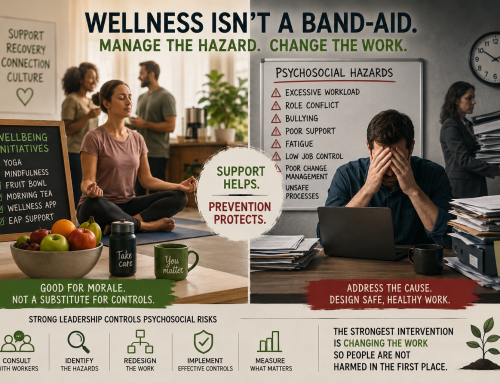
Safe Work Australia identifies leadership, two-way communication, fairness, dignity, respect, role clarity and supervisor support as important parts of organisational culture. Its guidance on psychosocial hazards also recommends consulting workers, observing behaviours and treating concerns seriously rather than relying on surveys alone.
A culture that discourages people from reporting problems can allow psychosocial hazards, operational risks and harmful behaviours to continue unnoticed or unchallenged.
This means leaders cannot delegate culture entirely to HR, communications or an annual engagement process. Senior leaders and line managers create culture through the decisions they make and the behaviour they permit every day.
How leaders can examine the real culture
A culture review should not stop with, “What are our scores?”
Leaders need to explore the experiences sitting behind them.
Five useful questions are:
- What happens when somebody brings us bad news?
Look at the leader’s first response, not just the eventual process. - What issues are discussed privately but rarely raised formally?
Silence in a meeting does not always mean agreement. - Which commitments have employees heard repeatedly without seeing action?
Unfulfilled promises gradually reduce the value of every new promise. - Who is treated as an exception to our behavioural standards?
Exceptions reveal what the organisation values most. - What have people stopped raising because they no longer expect change?
This may be one of the most important culture questions a leader can ask.
The purpose is not to uncover every complaint or encourage constant criticism. It is to identify patterns that may be limiting performance, learning, trust and psychological safety.
Culture is created on an ordinary Tuesday
Culture is not built only during strategy days, leadership conferences or annual surveys.
- It is created during routine meetings, performance conversations, project setbacks and moments of disagreement.
- It is created when a leader admits they were wrong.
- It is created when a concern is followed through.
- It is created when a strong performer is held accountable for poor behaviour.
- It is created when people see that raising a difficult issue leads to curiosity and action rather than blame or avoidance.
At Career Life Transitions, we have long taken the view that managing culture is a central leadership responsibility. Assessments, surveys and HR processes can provide valuable information and support, but leaders still have to convert stated values into consistent everyday behaviour.
Your culture report will show part of the picture.
Your people are living the rest.
And the deeper question for every leadership team is not simply, “What culture do we say we have?”
It is:
“What have our people learned to expect from us?




Dr Susan Roberts says: