

Australia is in the middle of a demographic shift that is far more profound than it first appears. By 2029, every baby boomer will have reached retirement age. On paper, that sounds like a neat milestone. In reality, it marks the beginning of a much more complex chapter for individuals, employers and the broader economy.
Retirement is no longer a clean break at 65 followed by a predictable period of leisure. It has become layered, uneven and, for many, uncertain.
Longer Lives, Longer Retirements
In 1930, average life expectancy in Australia was around 63. There was barely a retirement phase at all. By 1970, life expectancy had risen to 71, allowing perhaps six years beyond full-time work. In 2024, Australians can expect to live to around 84. That translates into close to two decades of post-work life.
At the same time, the ratio of working-age Australians to those over 65 has shifted dramatically — from 7.5 workers per retiree in 1970 to a projected 2.7 by 2050. This is not just a personal issue; it is a structural one. Fewer workers supporting more retirees changes everything — from tax revenue to healthcare demand to workforce planning.
The Three Phases of Retirement
Retirement itself is no longer one uniform stage. Broadly, it tends to move through three phases:
- Active retirement – travel, hobbies, volunteering, contribution.
- Passive wind-down – reduced energy and increasing leisure.
- Sedentary phase – greater reliance on support and care.
The duration of each phase varies enormously. Some people enjoy 20 vibrant years. Others face health challenges much earlier. The key point is this: retirement is a long season, not a short holiday.
Two Australia’s in Retirement
There is also a widening divide.
One group has choice. They scale back gradually. They consult, mentor, volunteer or contract part-time. Work becomes optional — a source of stimulation or lifestyle funding.
The other group has far fewer options. Superannuation balances are modest. Downsizing is complicated by stamp duty and limited housing stock. Rising living costs eat into savings. For them, working longer is not lifestyle design — it is financial necessity.
The shrinking middle class is amplifying this divide. The retirement experience increasingly depends on asset ownership and income history.
Why Many Boomers Are Still Working
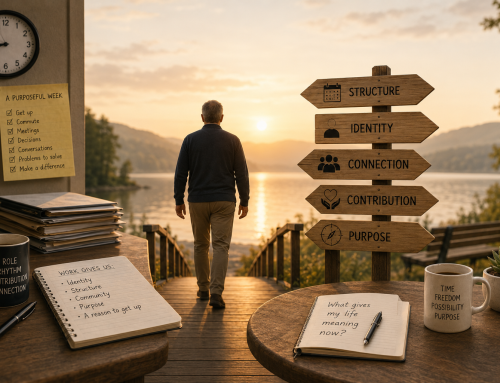
Not all older Australians remain in work because they have to. Many are healthier than previous generations. Work is less physically punishing than it once was. Knowledge-based roles allow longevity. More importantly, work provides five powerful anchors:
- Routine
- Identity
- Relationships
- Purpose
- A sense of control
When those disappear suddenly, the consequences can be significant. Research consistently shows that loneliness is as damaging to health as smoking 15 cigarettes a day. Around 20% of people over 60 experience diagnosable mental health conditions. Retirement, if unmanaged, can trigger what some call the “three D’s”:
- Divorce
- Depression
- Decline
The issue is not retirement itself — it is the absence of replacement meaning.
The Business Case for Rethinking Retirement
For organisations, this demographic shift is not theoretical.
If a significant proportion of employees over 60 plan to retire within the next five years — and many do — the loss of institutional knowledge can be abrupt and costly.
At the same time:
- Around 60% of mature-age workers manage at least one chronic condition.
- Mental health claims are significantly more expensive and longer in duration than physical injury claims.
- Secondary psychological conditions can multiply claim costs and time away from work.
Proactive workforce planning is no longer optional. Organisations must ask:
- What percentage of our workforce is over 50?
- What are their retirement intentions?
- How are we capturing knowledge?
- What flexibility options exist?
- Do managers know how to have transition conversations lawfully and respectfully?
Ignoring these questions increases redundancy risk, compensation exposure and capability gaps.
Retirement Is Becoming a Transition, Not an Event
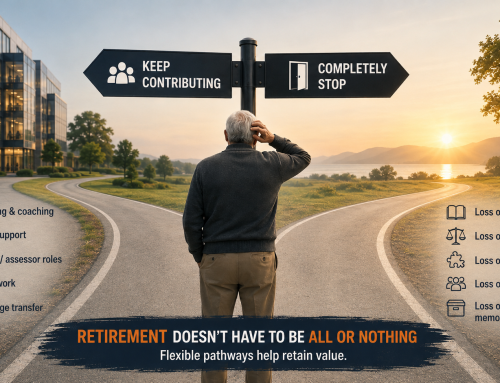
The old model — full-time work one week, farewell cake the next — is fading. What is emerging instead is a phased transition:
- Reduced hours
- Project-based work
- Mentoring roles
- Work-from-home flexibility
- Planned knowledge transfer
- Extended leave as a “trial retirement”
This gradual approach benefits both parties. It allows employees to retain control while enabling organisations to plan succession more intelligently.
Starting these conversations earlier — often from age 45 onwards — leads to better outcomes. Not because retirement is imminent, but because lifestyle design requires time.
Planning Beyond the Finances
Financial readiness matters. Superannuation strategy, pension eligibility, asset structure and tax planning all influence lifestyle options.
But financial planning alone is not enough.
A meaningful transition plan also explores:
- Family – care responsibilities, grandchildren, ageing parents
- Work – volunteering, mentoring, casual income
- Mind – mental stimulation and cognitive health
- Body – physical activity suited to life stage
- Social connection – clubs, causes, community
- Learning – new skills or interests
- Values – what now matters most
Retirement is a whole-of-life redesign.
Studies suggest that retirees with a positive outlook on retirement live significantly longer than those who view it negatively. Attitude, structure and engagement are protective factors.
What This Means for Australia
Encouraging older Australians to remain engaged — whether through paid work, mentoring, volunteering or community leadership — is economically and socially beneficial.
With centenarians now among the fastest growing demographic groups, longevity is not a theory. It is reality. The question is no longer, “When do we retire?” It is:
- How do we design the final third of life?
- How do businesses prepare for demographic inevitability?
- How do individuals replace the structure and meaning work once provided?
Retirement is not disappearing. It is evolving.
The organisations and individuals who treat it as a strategic transition — rather than a sudden ending — will navigate this shift with far greater resilience.
And in a country ageing as rapidly as Australia, that resilience will matter more than ever.




Dr Susan Roberts says: