

Viktor Frankl noticed something after the Second World War that still has something important to teach us about retirement.
As a psychiatrist, he observed that many people did not feel most unsettled when life was busy, demanding or difficult. They often felt worse when life became quiet. Sunday afternoon, in particular, seemed to expose something. The workweek had ended. The noise had reduced. The expectations had paused. And in that stillness, people became aware of a hollow feeling they could not quite name.
Frankl called this “Sunday neurosis”. It was not really about Sunday. It was about what happens when the structure that carries us through the week suddenly disappears.
That idea has a powerful relationship with retirement.
For many people, work is not just a job. It is scaffolding. It gives the week shape. It provides a reason to get up, a place to be, people to talk to, problems to solve and a role to occupy. It gives us identity, rhythm, status, community and a sense of usefulness. Even when work is stressful, tiring or frustrating, it still performs a psychological function. It tells us where we belong.
Then retirement arrives.
At first, it may feel like freedom. No alarm. No commute. No meetings. No one needing an answer by close of business. The calendar opens up. The pressure lifts. People often say, “I just want time to myself.” And they mean it.
But after the first wave of relief, something else can appear. The days begin to blur. The phone rings less often. The casual conversations disappear. The familiar role fades. Decisions that used to be made by the workplace now have to be made personally. What time do I get up? Who do I see? What am I working towards? What matters now?
This is where Frankl’s observation becomes so relevant. The discomfort is not laziness. It is not ingratitude. It is not a failure to enjoy retirement. It is the human mind adjusting to the sudden loss of external structure.
Retirement is not simply the end of work. It is the removal of a whole operating system.
In Australia, this matters more than ever. We are living longer, working longer and moving through retirement in less predictable ways than previous generations. According to the Australian Bureau of Statistics, in 2024–25 there were 4.5 million retired Australians aged 45 and over. More than 800,000 people intended to retire within the next five years, and a significant number did not know when they would leave the workforce. Retirement is no longer a single date. It is a long transition.
And for many, it may last 20 or 30 years.
That is why financial planning, while essential, is not enough. Superannuation matters. Centrelink matters. Income streams matter. But a financially secure retirement can still feel empty if the person has not thought about identity, purpose, relationships, health, contribution and the use of time.
Frankl’s work reminds us that human beings do not live well on comfort alone. We need meaning. We need something to move towards. We need to feel that our life is still asking something of us.
This is one of the hidden challenges in retirement planning. Many people spend decades preparing financially for retirement, but very little time preparing psychologically for the transition. They know what they are retiring from, but not always what they are retiring to.
That distinction matters.
Retiring from work is an exit. Retiring to something is a transition.
Without a clear “to”, people can drift. They may fill their time with busyness, distraction, travel, errands, television, home projects or social activity, yet still feel oddly unanchored. The issue is not whether the calendar is full. The issue is whether life feels meaningful.
This is where the Sunday afternoon feeling becomes a warning signal. It tells us that we may have outsourced too much of our meaning to work. We may have confused productivity with purpose. We may have allowed our job title to carry more of our identity than we realised.
For some people, retirement is deeply positive. It can bring relief, renewed energy, better health, more time with family, new learning, volunteering, travel, creative expression and a chance to live in a more deliberate way. Research has shown that retirement can even create a renewed sense of purpose, particularly for people leaving work that has become physically demanding, stressful or unsatisfying.
But positive retirement does not usually happen by accident. It needs design.
A healthy transition requires people to think about five things.
The first is structure. Not the rigid structure of employment, but enough rhythm to give the week shape. Human beings need orientation. A blank calendar may look attractive, but too much unstructured time can quickly become unsettling.
The second is identity. People need to answer the question, “Who am I when I am no longer my role?” That can be confronting, especially for those who have spent decades being known by their profession, expertise, status or contribution at work.
The third is connection. Work often provides a social world that is easy to underestimate until it disappears. Casual chats, shared problems, humour, recognition and belonging are not small things. They are part of wellbeing.
The fourth is contribution. Many people do not want to keep working full-time, but they do want to feel useful. That contribution may come through mentoring, volunteering, family, community, creative work, part-time employment, advocacy or learning. The form matters less than the sense that one’s experience still has value.
The fifth is purpose. Purpose does not have to be grand. It does not have to be a mission statement. It can be practical, personal and quiet. It might be helping grandchildren grow, restoring health, supporting a partner, building community, writing family history, mentoring younger people, travelling with intention or finally giving time to a long-neglected part of the self.
For organisations, this is also an important workforce issue.
Mature-age employees often carry deep organisational knowledge, customer understanding, technical memory, relationships and cultural wisdom. When their transition is left unspoken until the resignation letter arrives, the organisation loses the opportunity to plan well. Succession becomes rushed. Knowledge transfer becomes incomplete. Managers are left guessing. Employees may disengage quietly because they are uncertain about their own future.
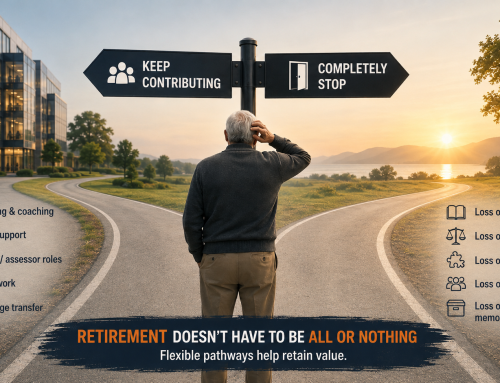
A better approach is to create safe, respectful opportunities for mature-age employees to think about the next stage of life before they are forced into it. Not to push them out. Not to make assumptions about age. But to support better planning, better conversations and better outcomes for both the employee and the organisation.
The best retirement transition programs do not simply ask, “When are you leaving?” They ask better questions.
- What do you want the next stage of life to look like?
- What would make it meaningful?
- What knowledge do you want to pass on?
- What are you worried about?
- What conversations have you avoided?
- What would help you make this transition with confidence?
Frankl’s Sunday neurosis reminds us that the quiet can be confronting, but it can also be useful. The unease that appears when work slows down is not something to be dismissed. It may be the beginning of an important conversation.
Retirement should not be treated as falling off the edge of employment into empty space. It should be treated as a major life transition that deserves thought, structure and support.
The real question is not only, “Have I saved enough?” It is also, “What will give my life meaning when the old structures fall away?”
That is the heart of retirement transition. Not just leaving work, but learning how to live the next stage with purpose.





Dr Susan Roberts says: