

Across many organisations, a quiet shift happens as employees move through their late-50s and into their 60s.
- They care less about titles.
- They’re less interested in competing.
- They’re more interested in giving something back.
They want to share what they know, support younger colleagues, contribute to culture, and feel useful beyond KPIs. In psychology, this pattern is well documented. In organisations, it is often overlooked—or worse, treated as a signal that someone is “winding down”. That’s a missed opportunity.
What’s actually happening psychologically?
Later mid-life and early older adulthood often bring a shift in motivation. People become more focused on meaning, contribution, and relationships, rather than advancement or accumulation.
Psychologists refer to this as generativity—the drive to invest in the next generation through mentoring, teaching, coaching, and stewardship. This isn’t about altruism alone. It’s about identity, purpose, and legacy.
At the same time, people become more selective about how they use their time. As future time feels more finite, emotionally meaningful work—supporting others, strengthening culture, leaving things better than they found them—takes priority.
Becoming a grandparent can accelerate this shift for some people, but it’s not the cause. The same motivation shows up just as strongly in people who mentor graduates, support apprentices, or quietly hold teams together through change.
Why this matters to organisations
Many organisations unintentionally design roles, performance systems, and career paths that peak at mid-career and then flatten out. When that happens, experienced employees often:
- Disengage quietly
- Retire earlier than planned
- Withhold knowledge rather than transfer it
- Feel invisible rather than valued
Yet research consistently shows that people who are able to express generativity—through mentoring, contribution, and service—report higher wellbeing, stronger engagement, and greater sense of purpose. For organisations, that translates into retention, stability, and capability lift.
This is not about keeping people forever. It’s about using their final chapters well.
The organisational benefits (when done properly)
When organisations actively leverage this stage of working life, they gain:
- Knowledge retention: Decades of tacit knowledge don’t walk out the door unshared. Critical judgment, context, and “how things really work” get transferred—not lost.
- Stronger capability development: Younger employees benefit from real-world mentoring that goes beyond formal training. Learning accelerates when it’s relational.
- Cultural continuity: Experienced employees often become custodians of values, standards, and behavioural norms—especially during growth or change.
- Engagement at both ends of the workforce: Older employees feel valued and purposeful. Younger employees feel supported rather than abandoned.
- Smoother succession: Leadership transitions become less abrupt and less risky when mentoring and handover are intentional.
How HR can practically leverage this phase
This does not require creating “special roles” or sidelining people into advisory corners. It requires designing work differently.
- Make contribution visible and valued: Recognise mentoring, coaching, and knowledge-sharing as real work—not side hobbies. Include it in role design and performance conversations.
- Create structured mentoring pathways: Formalise graduate mentoring, peer coaching, and technical stewardship roles. Clarity matters—people want to know how they can contribute meaningfully.
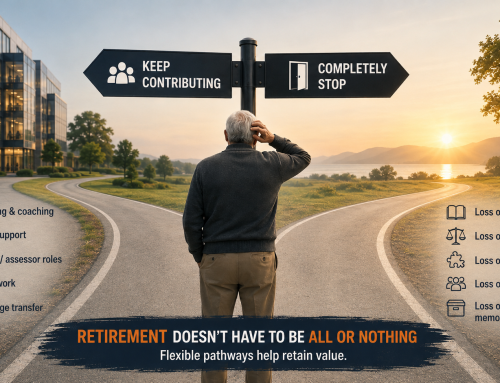
- Rethink late-career pathways: Not everyone wants to “step up” or “step down”. Some want to step sideways into roles with greater influence and less noise.
- Use them during change: Periods of transformation are where experience matters most. Involve senior employees as stabilisers, translators, and guides—not just observers.
- Talk about purpose, not just retirement: Career conversations in the 60s shouldn’t start with exit plans. Start with questions like:
- What do you most want to pass on?
- Where do you see younger people struggling?
- How would you like to contribute over the next few years?
A final thought for HR leaders
The question isn’t whether people in their 60s still have value. The question is whether organisations are designed to receive it. When organisations make room for contribution, mentorship, and legacy, they don’t just retain experience—they multiply it. And in a tight labour market, that may be one of the most underused advantages you have.





Dr Susan Roberts says: